
Abandoned & Little-Known Airfields:
Texas: Central Fort Worth area
© 2002, © 2025 by Paul Freeman. Revised 5/8/25.
This site covers airfields in all 50 states: Click here for the site's main menu.
____________________________________________________
Please consider a financial contribution to support the continued growth & operation of this site.
Oliver Farms Airfield / Summers Airfield (revised 10/9/24) - Saginaw Airport (revised 5/8/25)
____________________________________________________
Saginaw Airport (F04), Saginaw, TX
32.86, -97.38 (Northwest of Fort Worth, TX)
Saginaw Airport, as depicted on the March 1947 Dallas Sectional Chart (courtesy of Chris Kennedy).
Saginaw Airport is one of the large number of general aviation airports
which have been swallowed up by "development" in the Dallas - Fort Worth metro area.
Saginaw Airport was not yet depicted on the March 1946 Dallas Sectional Chart.
According to an article entitled "A Home for Slow Airplanes" by Walt Shiel, Saginaw Airport was built by John MacNeil shortly after WW2.
It originally had only a grass runway & an aluminum maintenance hangar.
The earliest depiction of Saginaw Airport which has been located was on the March 1947 Dallas Sectional Chart (courtesy of Chris Kennedy).

The January 1948 Dallas Local Aeronautical Chart depicted Saginaw Airport as having a 2,600' unpaved runway.

The 1948 USAF Urban Area Chart depicted "Saginaw Airfield"
simply as a rectangular outline, without any depiction of runways.

The earliest photo which has been located of Saginaw Airport was a 4/1/52 USGS aerial view.
It depicted the field as having 2 unpaved runways, with a row of T-hangars on the southwest side,
and the main hangar, 1 long hangar, and 3 light single-engine aircraft on the south side.

The 1955 USGS topo map depicted Saginaw Airport
as having 2 unpaved runways, with numerous buildings on the south side of the field.
A 1956 aerial photo still showed Saginaw Airport having unpaved runways.
Saginaw had gained a paved runway at some point between 1956-62,
as the 1962 AOPA Airport Directory described Saginaw Airport
as having a 2,650' hardtop Runway 18/36 & a 2,400' turf Runway 13/31.
The operator was listed as a J. D. McNeill Jr.
A 1963 aerial view showed Saginaw's newly-paved Runway 18/36.
Ganey Bradfield recalled, “Saginaw Airport was run by a man named McNeill.
He was pretty grouchy & rather 'by the book'. His wife did most of the day to day operation stuff.”

The 1963 TX Airport Directory (courtesy of Steve Cruse)
depicted Saginaw Airport as having a row of T-hangars along the west side, 3 rows of t-hangars east of Runway 18/36,
and the office & main hangar adjacent to the ramp.

Saginaw Airport, as depicted on the 1964 DFW Sectional Chart (courtesy of Ross Richardson).
Eddie Shaw recalled, “I learned to fly out of Saginaw, started flying there in September 1965 & soloed in February 1966.
J.D. McNeil operated 2 Cessna 140s & an Aeronca Champ in the flying school.
The late-model (1950) 140A was the preferred airplane, but of course came with a premium price, like $13/hour,
so I flew the Aeronca most since it was less expensive, something like $9/hour, although I did solo in one of the 140s.
My dad taught me to fly so I saved money on the dual instruction part.
J.D. was a retired American Airlines pilot & was pretty crusty, his wife did most of the 'public relations' but they ran a very nice airport.
In November 1967 I also got my multi-engine rating at Saginaw in a Cessna 310B that J.D. McNeil had in the school.”
I will always remember those days at Saginaw, the airports just aren't the same now.”
The 1967 TX Airport Directory (courtesy of Brad Stanford) listed the operator at Saginaw as McNeill Flying Service.

A 1970 aerial view depicted Saginaw Airport as having one paved runway & one grass runway.
Several hangars were visible on the south end of the field, as well as 5 light aircraft.

The February 1973 Dallas Sectional Chart (courtesy of Ron Plante) depicted Saginaw Airport as having a 2,600' paved runway.
Lane Crabtree recalled, “Saginaw Airport... I learned to fly there in 1974/75
and continued to fly out of there for another 5 or so years after I got my Private Pilot ticket.
I learned on their 2 Cessna 140s mostly, but flew their 150 for night hours & other times that we needed a working radio.
The 140s were pretty much daytime only flyers and had old, almost useless, radios.
But, I enjoyed the 'rag wing' 140 as it had much better performance over the all-aluminum 140A.
They also had a nice Cessna 182 with two 42 gallon long-range tanks that was lots of fun to fly.
Never got enough hours to qualify to fly their Bonanza. I did get a few short hops in their 2 Cessna 310s.
I also worked out there for a year from about 1975-76, doing usual airport duties such as refueling, towing, and maintenance.
Supposedly, I thought I'd get some cross country flights with McNeil, but that never happened.
At $2.50/hour, I certainly wasn't there for the money.
After it appeared I wasn't going to get invited on Air Taxi & Air Ambulance flights with McNeil, I found work elsewhere to pay for flying time.
I will say it was interesting to hear some of the flying stories told by McNeil in the office on days where it was raining or otherwise not great flying weather.
As some have said, he could be a bit gruff, but it wasn't directed at you personally, just the way he was.
Other pilots & airport bums dropped by from time to time who had their own great stories & jokes.”
Lane continued, “Just before I got my license, long time Saginaw Airport A/E mechanic Richard Burton got cancer, and passed away a year later.
That left Bob Eggenburger to do most of the annuals & other maintenance after he got off his day job at General Dynamics.
Bob was a real workhorse & never seemed to sleep. I don't know how he did it all.
Most of the 'airport bums' as we called them, were professionals such as MD's, oil men, engineers & quite a few owned Bonanzas.
We also had a former Air Force test pilot, Richard Johnson, who owned an early V35, who once held the speed record in an F-86.
He later flew the F-111 as a GD test pilot. Pretty good guy & he gave me a free biennial checkride once.”

The July 1976 DFW Terminal Chart (courtesy of Jim Hackman) depicted Saginaw as having a 2,600' paved runway.
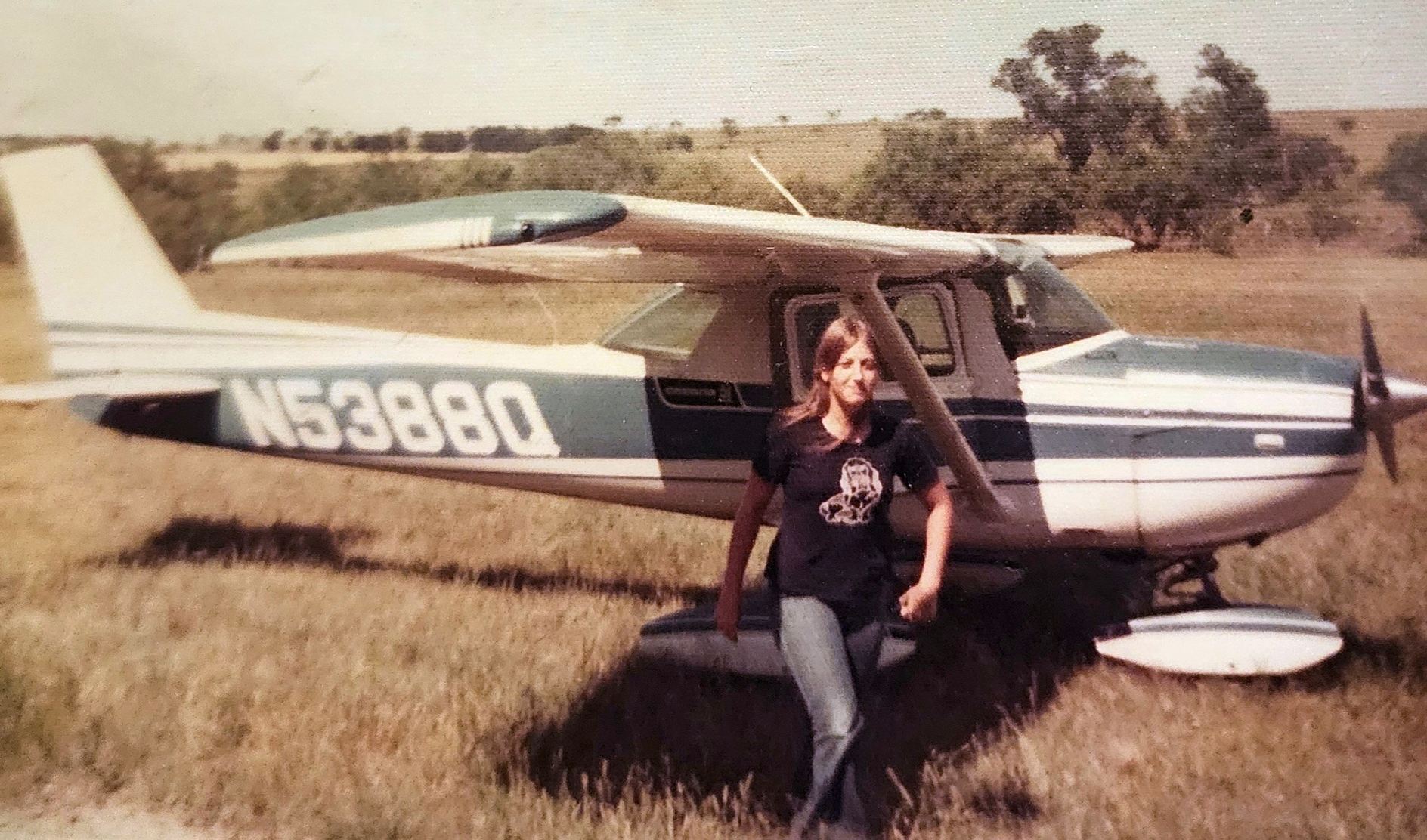
A circa 1975 photo of Andra Beatty in front of N5388Q, a 1972 Cessna 150L in which her dad had paid for her to take a flying lesson from Saginaw Airport.

A 7/12/79 photo of N81331, a 1946 Fairchild 24R-46, serial #R46231, at Saginaw Airport.

A late 1970s / early 1980s photo of “Lane Crabtree refueling a Cessna 400 series at the fuel pit” at Saginaw.

A late 1970s / early 1980s photo of “Lane Crabtree exploring the hulk of a Twin Beech that sat on the airport for decades” at Saginaw.

A late 1970s / early 1980s photo by Lane Crabtree of the “Saginaw Airport office.
Mrs. McNeil's office was behind the pocket door. The office was spartan, but functional.”
According to an article entitled "A Home for Slow Airplanes" by Walt Shiel,
John MacNeil sold Saginaw Airport & its 150 acres when they retired in the early 1980s.
The new owner sold off a 40 acre parcel to a grocery store chain, shrinking the size of the airport.
However, the new owner stopped making payments on the remainder of the property to MacNeil, causing MacNeil to repossess the airport.
The airport had been allowed to deteriorate by the second owner, necessitating much cleanup work.

A September 1983 photo of N1541D, a 1952 Cessna 195, serial #7763, inside a Saginaw Airport hangar.
By 1985, the manager was listed as Scotty Boggs in the 1985 TX Airport Directory (courtesy of Steve Cruse).
Brian Goad recalled, “I used to fly an L-4 & a Stinson 108-1 out of Saginaw
in the late 1980s & early 1990s when TMark Aviation was operating it.
On occasions, Mark used to let me fly his yellow Cub he had beautifully restored;
it was a special treat for me to do so.
His restored Cub looked & felt as though it had just rolled off Piper’s assembly line;
I should have bought it when he offered to sell it to me.”
Brian also flew an L-4 from Saginaw.
“After Oliver Farms closed, the L-4 was brought over to Saginaw.
My dad owned the L-4, but since he was so busy flying the BT-15,
he asked me to maintain it & fly it to shows… I couldn’t have asked for a better deal.
For several years, the L-4 occupied the second stall from the west on the south side of the middle 3 T-hangars.”
Brian recalled, “The best times of my life were spent at our Saginaw play days
and even on raining days sitting in the big hangar drinking beer & telling stories.
Usually, everyone with the little birds would come out after work on Friday evenings,
go dog fight for a bit, disengage mock battle to enjoy the countryside for a little while,
then come back joining up to do a little formation flying.
It wouldn’t take long & the parking lot would be dotted with spectators
(including the Saginaw Fire Department & their fire truck) all asking if there was an air show going on.
We must have looked pretty impressive in the Cubs, Champs, and L-birds.
After the flying was done, well of course it was beer time, more stories,
and endless joking & laughing, or even help add a stitch or two to one of Mark’s projects.
Saginaw Airport was the place to be on a Friday evening or Sunday.
I have many fond memories of the Saginaw days; they were the best.”
Brian continued, “It was a small world for me there at the airport.
Mark Heffley’s younger cousin Todd Heffley had a Champ based there.
I was friends with Todd’s older sister when he was just a little kid.
I recall Todd threw acorns at me & squirted me with the water hose back then.
Now that 'little kid' was flying off my wing.
The small world continued when another Cub owner named Tim showed up; his wife was in my high school class.
Then there was John Gronemeyer with his L-5. I had met John through the Confederate Air Force.
So with Mark, Todd, Tim, John, a few others, and I, we kept Saginaw Airport very active & a fun place to be.”
Brian described the grass strip at Saginaw as “the smoothest I had ever touched down on.
It was so smooth you never knew when you crossed over the asphalt.
However, some pilots made it a contest to touch down on the grass
before crossing the dirt taxi strip that lead to the hangars on the west side.
But if you didn’t get it just right, that little dirt hump would bounce you back up into the air
like a Harrier Jump Jet taking off a curved deck.
I never could do it right; needless to say, I always landed long in the grass & made ‘perfect’ landings every time.”
Brian continued, “I did have to use the grass cross runway once.
While I was out & about in the L-4, the wind had picked up out of the southeast,
and so strong that I managed to touch down & stop in about 30 to 40 feet.
Good thing I had an excellent instructor for tail-dragger,
otherwise I probably never would have been able to taxi back to the hangar, the wind was that bad.”
Brian continued, “Now, Saginaw did not have a lighted runway;
however, there were times some of us flying the little birds got caught out after dark.
Should this happen, us locals would execute the ‘Dairy Queen Approach’ to Saginaw.
The Dairy Queen to the north of the airport had a huge American flag brightly lit,
and that was our marker to turn due south & less than a mile you would be lined up over the runway
to make a north to south low pass checking for obstacles on the runway (i.e. cars, motorcycles, or coyotes).
Mark was always checking to see who hadn’t made it back in before dark
and he would leave the shop lights on which marked the south end of the runway.
This was important since holding a 2-D cell flashlight out the door never made for a good landing light on the L-4,
and especially since it took both hands to land the plane.”
Brian continued, “It was the opinion of most of the local pilots at Saginaw
that the student pilots flying in & out of Meacham Field had no clue that another airport (Saginaw)
was near their parallel runway approach centerlines.
The small planes coming into Meacham were always off line and/or too low, and constantly invading our airspace.
We had to keep a close watch for those students & be ready to bale out west or simply dive for the runway;
I got plenty of practice ‘slipping’ the L-4 in.”
In 1990, Saginaw was leased by John MacNeil to Mark & Tara Heffley.
They operated TMark Aviation, which specialized in restoration of tail-draggers.
Paul Johnson recalled, “I rented hangar space from Mark & Tara from August 1992 until September 1996.
I rented the (very) little garage apartment behind Mr McNeill's house from January 1993 until August 1996.
Living with my airplane really impressed the young women I was dating back then... until they got to know me... hah!
Some of THE happiest days of my 41 years of life were spent committing aviation at F04...
until April 1996 when Mark was diagnosed with brain tumors, which would not stop growing back when removed.
Mark graduated from this life in October 1996, at the age of 42.
Tara made a magnificent attempt to keep T-Mark Aviation aloft, but the deck was stacked against her.
The elderly Mr. McNeill's daughter Barbara had really talked up the idea of making F04 an airpark,
but no attempts to bring this to fruition were ever seen by any of us.
The general consensus among Saginoids & lurkateers
was that Barbara was simply biding her time until she could do as she pleased.”
Paul continued, “I first experienced F04 in July of 1992,
when, a-shopping for hangar space for my 'Baby 180' (fastback tailwheel 1962 C-150),
I drove my truck onto the runway following Cooper Heffley (Lenard Loopner's youngest child) on his dirtbike,
leading me to meet the airport manager (Mark), who was flying radio-controlled models with Lynn & their younguns.
They had parked 'Paw Paw Heffley's' immaculate early-model GTO out there on the east shoulder of the runway
and were enjoying refreshing sudsy beverages while entertaining & instructing their younguns
with radio-controlled antics of derring-do.
They offered me such a beverage & it occurred to me as I imbibed that I might have found My People.”
Paul continued, “The pre-start checks were amended by Lenard Loopner to include the admonition, 'RUN AWAY!'
A good start, takeoff, landing (especially), low pass, high speed pass,
batch of fajitas or extremely 'coldbeer' was termed 'ECK-cellent!'
Barf-bags were proffered to nervous first-time passengers
during our highly professional pre-flight briefings with the gentle advice, 'If yer gonna spew, spew in this.'
Of course the crinkled nose & high-pitched inflection & lisp of Garth Algar made it all the more effective.
If a particular crosswind, fastener combination, elusively dropped essential part,
extra-hot batch of salsa, decidedly pitched game of pool in the lobby, or too-stiff drink
were too much for one of our crowd, we entreated our compatriots for assistance with,
'It sucking my will to live!' & if greatly challenged, 'Oh the HUMANITY!'”
Paul continued, “It was once determined that all the trees trying to grow up through the westside T-hangars should be cut down.
Mark, Todd, another corporate pilot named Mike Canaday & myself assayed to effect such clean-up.
It was quite a weekend of hard work & hair-raising crashes of the mighty chinaberry to earth.”
Paul continued, “Tara in the mid 1990s hadn't flown professionally for 10 years,
due to making babies & founding T-Mark, and she STILL had more hours than Mark.
Mark took a lot of ribbing about that... but he just grinned... because he had... her!”
Paul continued, “Lynn Heffley, Mark's brother & Tim Carter's co-owner in a couple of aircraft,
lived in Mr Mcneill's house for the first several months that I was there.
Then a corporate pilot/furloughed USAIR pilot named Steve Wilkey was there for few months.
He co-owned a Pitts S-1S with Billy Brock, who with 500 hours total time,
made a flawless pasture-landing in it near Decatur when it threw a rod.
Then Todd & Cindy Heffley lived there with Gee Bee, their little orphan pup from the pound,
probably the last 2 years I was there, & for a while afterward.
A corporate pilot named Alex Knezky moved into the garage apartment in September 1996,
when I moved to my new place at Rhome Meadows.
I love that F04 & dem Hoeflexes, Saginoids & lurkateers.
Oh how my heart yearns for a return to such blissful days & fast friendships which weren't shallow.
Words cannot how profoundly my life has been impacted as a result of my season as a Saginoid.
There are F04-shaped voids in many hearts.”
Tim Carter recalled, "I hangared a Pitts S2B there for a while (in the main hangar).
About once a month during the summer we would have a 'Cub Sunday'.
Usually advertised at nearby airports & sometimes catered by a local restaurant.
They were well attended & many rides were given to visitors."
"I'll stake claim to the last student known to fly his initial solo at Saginaw.
I soloed my son, Patrick Carter there on 5/3/98.
There could have been some since then, but I don't know of them,
and will claim the title until someone steps forward with a later date.
Patrick soloed in a Henderson Little Bear which is a J-3 Cub replica.
There were few years afterward there that someone else could have [soloed],
but the airport was not very active then & there was no commercial operation there at all (other than gas sales).
The grass area on the sides of the runway were used for landing as well as the pavement.
It was probably the smoothest grass strip I ever landed on."
Saginaw's grass Runway 13/31 was evidently abandoned at some point between 1985-95,
as a 1995 USGS aerial photo showed the the crosswind runway no longer cleared.
No planes were visible on the field.

The last aeronautical chart depiction which has been located of Saginaw Airport was on the October 1998 Dallas Terminal Aeronautical Chart (courtesy of Ron Plante),
which depicted Saginaw as having a 2,600' paved runway.

An undated aerial view looking southwest at Saginaw Airport, © 1995 Walter P. Shiel, used by permission, all other rights reserved.
For more information: http://www.cessnawarbirds.com/articles/
The 2000 AOPA Airport Directory described Saginaw as having a single 2,600' asphalt Runway 18/36.

The last photo which has been located showing any aircraft at Saginaw Field was a 3/15/02 aerial view looking northwest,
which showed 2 light aircraft parked outside.
Steve Thomas recalled, “My acquaintance with Saginaw goes back to July 2002.
I purchased a 1962 Piper Colt N5521Z located at Saginaw.
It took us 2 days of flying to get her to its new home at Hampton Roads Executive Airport in Portsmouth, VA.”

An 8/02 photo by Paul Freeman, looking north along Saginaw's Runway 36, less than 2 months before the airport was closed.
Paul Freeman visited Saginaw Airport in August 2002 (unaware that the field would be closed in a mere 2 months).
It was a sad sight - obvious that the field was on its last legs.
Although all of the T-hangars appeared to be occupied by light aircraft,
there were no transient aircraft, and the office was locked tight.
Furthermore, there was hardly any street sign to indicate to passers-by that an airport was operating.
How is the general aviation industry & community going to survive
if we don't do a satisfactory job of bringing in new customers?
I drove up & down the length of the runway, poked around the hangars,
and the only person I saw on the field was a nice "old-timer",
who told me that plans had already been drawn up by the local government
to subdivide the airport property into plots for new houses.

An 8/02 photo by Paul Freeman of the T-hangars along the west side of Saginaw Airport.
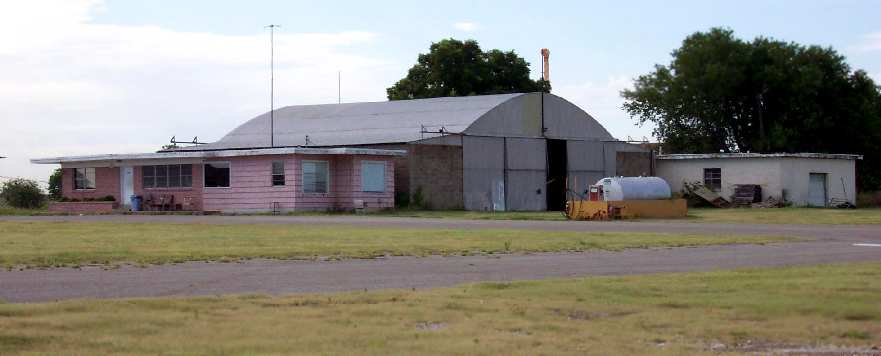
An 8/02 photo by Paul Freeman of the office & main hangar at Saginaw Airport.
Steve Thomas recalled, “I just so happened to be in the area again in late September 2002
and made a point to stop by once more this time by car.
A sad sight as no one was around & some of the hangars were already empty.
During this visit, was unaware the place was in its final days.”
According to Michael Reddick, Saginaw Airport was closed in November 2002.
The final takeoffs were staged on the day of the closing.
Barbara Beerling, daughter of airport owner J.D. McNeill, placed the yellow X's on the runway after the last flight out.
Saginaw was still listed in the 2003 Airport Facility Directory, although with the remark, "Airport closed permanently."
In its last year of operation, FAA statistics listed 40 aircraft as being based on the field,
and estimated the average number of takeoffs & landings as 39 per week.
In Michael Reddick's words, "Over 50 years of aviation history & tradition
will be plowed up for the construction of more homes & apartments that some people call progress!"
A 7/6/03 aerial photo showed Saginaw's runway marked with closed-runway “X” symbols,
but the field otherwise remained intact.

A November 2004 photo by Mark Morgan, looking northeast at the abandoned hangars at Saginaw Airport… "Just rotting into the ground."

A sad sight - a November 2004 photo by Mark Morgan, looking northwest at the abandoned hangars at Saginaw Airport.
Compare to the picture from the same perspective from only 2 years ago, when all of those hangars were filled with small planes.
Saginaw Airport was depicted as “Closed” on the 2004 Dallas Terminal Aeronautical Chart (courtesy of Jonathan Westerling).
A 1/2/05 aerial photo showed Saginaw's hangars remained intact,
but new streets & residential construction had covered the northeastern half of the property.

An April 2005 photo by Brian Goad – a sad view looking north along the former Saginaw runway.
The asphalt runway surface has been removed, along with 3 T-hangars.
“The shop, larger hangar, and office still remain. Note the encroaching new homes to the northeast.”

An April 2005 photo by Brian Goad, looking northwest from the south end of the former runway.
The open T-hangars on west side are gone, and a single stall hangar remains.

A June 2005 aerial view by Brian Goad, looking northwest at the former Saginaw Airport,
taken from an O-2A on final approach into Meacham Field.
The 3 T-hangars north of the main hangar had already been removed, with houses built just to the east.
A 6/27/05 aerial photo showed the Saginaw Airport T-hangars had been removed.

A circa 2010 aerial view looking east at the remaining hangars at the site of Saginaw Airport.

A May 2011 photo by Michael Sellers looking northeast at the start of demolition of the remaining structures at Saginaw Airport.
Michael reported, “This morning I noticed they were beginning tear-down on the last remaining structures.”

A May 2011 photo by Michael Sellers looking north along the former Saginaw runway.
Michael reported, “You can still make out the faint outline of where the runway & turn-around once was.
I haven't heard anything about what is happening to the property.
But, with all of the development going on around here, I'm guessing someone bought it to build a new subdivision on. Time will tell.”

An August 2011 photo by Pete Charlton of the main Saginaw hangar.
Pete Charlton observed in August 2011, “Things change around us in the blink of an eye.
Last July I was headed into Saginaw to have breakfast at JR's.
The sun was in my eyes, and as I moved east on McLeroy past Knowles Street I sensed something was different at the old airport.
Something was missing. Something was new.
What was missing was the older yellow brick house, its garage & the outbuildings around what had been the airport center.
In the space of a week, everything was changed. What was new was the hangar.
Not really new, but you never could really see it before because of the clutter.
It struck me as impressive, in a way. I stopped & pulled into the driveway for some pictures.”
Pete continued, “I have lived west of Saginaw since about 1997 and am into & out of the town several times a week, sometimes several times a day.
The land had been sold for development several years ago.
The paved runway had been plowed up & the T-hangars on both sides had been taken down with one exception.
Now on this day there is just the big hangar. However, that hangar took on a whole new dimension without the clutter around it.
The place almost becomes an Aerodrome in the classic sense. Built of common materials it still becomes a little stately in its appearance.
Solid. It has seen the best & worst of aircraft and probably some that were unique or improbable.
Just picture a stagger-wing Model 17 Beechcraft in front of it, or a big radial-engined Cessna 195.”
Pete continued, “I talked to the man who rents the hangar & he told me he thought the owner had the rest of the buildings pulled down & plowed under
because they were in bad shape & there were some liability problems.
He said he had no idea of what was in the future for the old hangar, but that it was serving his purposes nicely.
I suppose it it hopeless to think that someone might come up with some way to save the big old hangar & use it without too much change.
At 65+ years old it could be considered historic in a technical sense,
but I have an idea that the land is probably zoned commercial & if the economy ever turns around, then we'll see it disappear overnight as well.”

An August 2011 photo by Pete Charlton of a shed hangar which remains at Saginaw.
Pete observed, “There is one old building remaining to the west of the big hangar.
It's a closed shed hangar that has been used occasionally for 'estate sales', but everything else around it is gone.”

A 4/10/13 aerial view looking north at the remains of Saginaw Airport: 2 hangars, foundations, and most of the length of the formerly-paved runway.

A 2/5/17 photo by Matt Franklin of the main Saginaw Airport hangar.
Matt remarked, “Saginaw's 2 hangars are still standing, now featuring some broken windows.
You would never know where the runway used to be from the ground.
DFW is growing like crazy, and I can't help but think that unless you've got a 10,000' concrete runway, your local airport will turn into houses soon.”

A 2/5/17 photo by Matt Franklin of a shed hangar which remains at the site of Saginaw Airport.

A sad sight for anyone who loves general aviation: a 2017 aerial view looking northwest shows houses covering the majority of the site of Saginaw Airport,
but 2 hangars remain on the south side (bottom-left) of the property.

A 10/17/19 photo by Joe Wright of the very last vestige of Saginaw Airport: its former main hangar.
Joe reported, “It looks like the time has finally come. The occupants have been busy in the last few days clearing it out & preparing it for demolition.
The little T-hangar was demolished a few days ago, and all that remains of it is the slab.
Rumors abound as to what will become of the last acreage.”
Thanks to Mark Robinson for pointing out this field.
____________________________________________________
Oliver Farm Airport / Summers Inc. Airfield (04TX), Saginaw, TX
32.87, -97.4 (Northwest of Fort Worth, TX)

Oliver Farm Airport (as well as the nearby Saginaw Airport),
as depicted on the 1963 Tarrant County TX Highway Department Map (courtesy of Gainey Bradfield).
Oliver Farm Airport was one of 4 airfields which were once located
in a space of only 4 miles from east to west just to the northwest of Fort Worth.
Oliver Farm Airport was evidently established at some point in 1963,
as it was not yet depicted on a 1963 aerial photo.
The earliest depiction of Oliver Farm Airport which has been located
was on 1963 Tarrant County TX Highway Department Map (courtesy of Gainey Bradfield).
It depicted the field as having a single north/south runway.
Inexplicably, Oliver Farm Airport was not depicted at all on the 1966 DFW Local Aeronautical Chart.
The 1969 USGS topo map depicted a single unpaved north/south runway, labeled simply as “Landing Strip”,
with a few small buildings along the northwest side.
Colin Anderson recalled, “Oliver Farm Airport... I soloed from that airport in June 1969
and subsequently got my private certificate in the following August (we had only 1,800' at that time).
I became friends with Red Oliver who owned the airport & built it for his son Richard.
We did lots of goofy things (though they seemed OK at the time).
I had great times there & we had interesting happenings such as an FAA inspector crashing his plane (Stinson)
at the end of the runway after running out of gas.
Lots of people learned to fly there. We used to shoot jack rabbits there at night & often hunted doves during the day.”

The earliest photo which has been located of the Oliver Farms Airfield was a 1970 aerial view.
It depicted the field as having a single unpaved north/south runway, with 4 hangars on the northwest side of the field.
Jack Coats recalled, “Oliver Farm... I got my license flying from there in spring of 1970.
I rented a Cessna 150 there wet for $10/hour, and used it in instruction I took from a DFW Center Air Traffic Controller that 'relaxed' by training beginning pilots.
I was also in CAP, and flew the 150 with extended tanks (they could last 10 hours, but my bladder never could!),
an L4 (military Piper Cub with extended 'hat rack' to allow carrying a stretcher behind a pilot in the front seat), and a rebuilt CAP Funk aircraft from there.
Parachuters use the field too. The south end of the runway had a single-strand electric wire (I took out multiple times, by accident, landing too short)
and a barbed-wire fence (normal height, about chest high) on the North end. I was afraid of it & the power lines across the street!
One minor oddity, was that ALL traffic circled ONLY to the East.
Of you went to the West, you were in the controlled flight path of Carswell AFB.”
The earliest aeronautical chart depiction which has been located of the Oliver Farms Airfield was on the February 1973 Dallas Sectional Chart (courtesy of Ron Plante),
which depicted “Oliver” as a private airfield having an 1,800' unpaved runway.
The July 1976 DFW Terminal Chart (courtesy of Jim Hackman) depicted “Oliver” as a private airfield having a 2,200' unpaved runway.
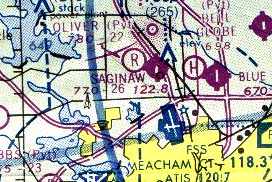
The last aeronautical chart depiction which has been located of the Oliver Farms Airfield was on the 1978 DFW Sectional Chart.
It depicted “Oliver” as a private airfield having a 2,200' unpaved runway, and indicated that the field conducted glider operations.
Oliver Farm Airport was described in the 1982 AOPA Airports USA Directory (courtesy of Ed Drury) as having a single 2,200' turf Runway 17/35.
The field was said to offer fuel, minor repairs, hangars, tiedowns, flight instruction, and plane rental.
Paradoxically, in spite of the above services, the field was described as “Private, use at own risk.”
The operator was listed as Oliver Farm Airport.

The 1982 USGS topo map depicted Oliver Farm Airport as consisting of a single 2,300' unpaved runway, with a cluster of hangars along the northwest side.
The field was labeled merely as “Landing Strip”.
Brian Goad recalled, “Dad originally had a PT-23 at Oliver Farms from about early 1985
until 3/6/87 when he lost a jug over Arlington & had to make an emergency landing in the UTA soccer field.
The PT-23 was damaged beyond repair, but dad came out with only a few cuts & stitches.
Then about mid 1988 dad got the L-4 & kept it at Oak Grove for a short time.
The L-4 ended up at the farm for a short time, and in late 1989 we moved it over to Saginaw.”
Christina Williams recalled, “ My grandfather, James 'Nat' Summers used to own Oliver Farm in the 1980s.
He changed the name to Summers Family Airport & my parents (Joe & Beverly Clay)
moved us to live there when my brother & I were very small children.
My dad was a pilot, flight instructor, aircraft mechanic & he also ran the gas pump (jack of all trades).
My mom made sure the light bulbs on the turf runway were replaced as needed among other duties.
I remember people from all over the world coming to Fort Worth to earn flight hours because it was cheaper in the US than most countries to do so.
I remember Richard Barrett, who was one of my dad’s best friends at the time.
Those years in Fort Worth on the family airport hold some of my family’s fondest memories.”

The only aeronautical chart depiction which has been located of the Summers Airfield was on the June 1988 Dallas Terminal Chart (courtesy of Ken Mercer).
It depicted “Summers Inc” as a private airfield having a 2,200' unpaved runway, but no longer depicted glider operations.
Summers Airfield was no longer depicted on the 1993 DFW Terminal Chart (courtesy of Jonathan Westerling).

A circa 1988 photo of Brian Goad flying his father's L-4
at Oliver Farm Airport's “Last First Annual Bash”, a few months before its closing.
Brian Goad recalled, “Oliver Farms was simply a cow pasture with open T-hangars.
I remember the first time I took my ex-wife there for her first flight in the L-4.
We turned off the road, opened the gate, drove south on the grass strip (cow pasture), and Brenda could see the planes in the hangars,
but turned & asked 'Where is the runway?' I said 'We’re on it.' Her eyes got a little wide.
I told her to watch her step when she gets out, because I didn’t want any cow #### in the plane.
I drive a little further & she sees the L-4 & says 'Oh, now that’s a cute little plane.'
I replied, 'Yep, and you’re gonna fly in it today.' And with even wider eyes, her response was 'OH!'
She freaked out when I didn’t close the window or door for the flight, but ended up loving it.”
Brian continued, “I remember the 'Last First Annual Bash' we had out at the farm.
Many planes flew in, we had a big cook out, spot landing contest, and played silly aviation games.
One in particular was where teams of 2 people would take a bed sheet out on the strip,
and the guys in the L-birds & Cubs would fly over & drop eggs
while the teams tried to catch the eggs in the sheets without breaking them.
We had cheaters in the planes, they didn’t just drop the eggs, they threw them at times.
My best friend brought his radio controlled L-4 (modeled after our L-4) and actually flew it in formation with the real L-4.
A real crowd pleaser.”
Brian continued, “After looking at dad’s log book, I just remembered that Oliver Farms was also called Summers.”
The date of closing of Summers Airport has not been determined.
It was no longer depicted on the June 1993 DFW Sectional Chart (courtesy of Ron Plante).

As seen in the 2001 USGS aerial photo, Oliver Farms / Summers Airport remained completely intact.

A circa 2002-2005 aerial view looking north at the former hangars of Oliver Farms, with the former runway area to the east.
A 1/2/05 aerial view showed Oliver Farm Airport remained intact, though deteriorated.
A 6/27/05 aerial view showed new streets & residential construction covering the southern half of the Oliver Farm runway site.
A 4/4/12 aerial view showed the 4 rows of T-hangars remained intact at the site of Oliver Farm Airport.
A 6/27/05 aerial view showed new streets & residential construction covering the southern half of the Oliver Farm runway site.

A 4/10/13 aerial view looking south at the site of Oliver Farm Airport showed 3 of the 4 rows of T-hangars had been removed.
Oliver Farm Airport is located southwest of the intersection of North Old Decatur Road & WJ Boaz Road.
____________________________________________________
Or if you prefer to contact me directly concerning a contribution (for a mailing address to send a check),
please contact me at: paulandterryfreeman@gmail.com
If you enjoy this web site, please support it with a financial contribution.
____________________________________________________
This site covers airfields in all 50 states.